
Reconnecting With Your Body During Pregnancy and Postpartum
A Functional and Compassionate Pilates Approach
Pregnancy and postpartum bring rapid physical changes that can feel disorienting. Many women are told to “listen to their body” without being given the tools to actually do that. In perinatal Pilates, the goal is not to control or reshape the body, but to reconnect with it through movement that supports posture, breath, strength, and confidence.
This approach centers function over appearance. Your body is adapting to support pregnancy, birth, and recovery. Movement can help restore trust in your body, reduce discomfort, and build resilience without pressure to look a certain way.
Below are seven gentle Pilates-based movements that support posture awareness, breathing, and whole-body connection throughout pregnancy and postpartum. Each can be adapted to meet your body where it is today.
1. All Fours Breathing With Gentle Spinal Movement
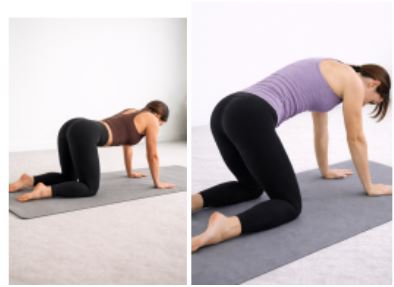
This position encourages expansive breathing into the back and sides of the ribcage while reducing pressure on the spine.
How to do it
- Come onto hands and knees with hands under shoulders and knees under hips.
- Inhale and gently arch the spine, lifting the chest and tailbone.
- Exhale and softly round the spine, allowing the head to relax.
- Move slowly for five to six breaths.
Why it helps
-
Supports spinal mobility
-
Encourages ribcage expansion
-
Reduces tension in the low back
Everyday Connection
This breathing pattern supports easier transitions in and out of bed and reduces stiffness after long periods of sitting.
2. Scapular Protraction and Retraction in All Fours
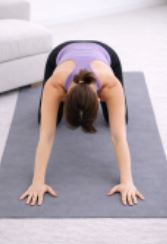
This movement builds upper body awareness without loading the core.
How to do it
- Stay on hands and knees with arms straight.
- Inhale and allow the shoulder blades to gently move toward each other.
- Exhale and press the floor away, widening the upper back.
- Repeat five to six times.
Why it helps
-
Improves posture and shoulder stability
-
Reduces neck and upper back tension
-
Builds awareness without strain
Everyday Connection
Helpful for carrying a baby, feeding positions, and prolonged phone or computer use.
3. Hug the Baby, Free the Baby Breathing
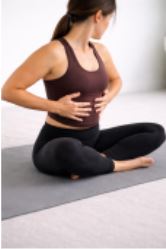
This cue encourages optimal posture and breath coordination without gripping the abdomen.
How to do it
- Sit or stand comfortably.
- On the exhale, gently wrap your arms around your ribcage as if hugging inward.
- On the inhale, allow the chest and ribs to soften and expand.
- Repeat for five to eight breaths.
Why it helps
-
Supports posture and spinal alignment
-
Encourages confidence and body awareness
-
Reduces excessive abdominal tension
Everyday Connection
This breathing pattern supports lifting, reaching, and transitions like standing up from a chair.
4. Supported Squat or Sit Squat
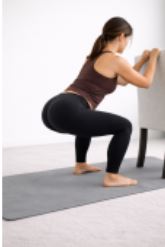
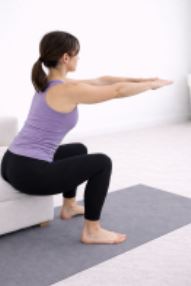
Squatting supports pelvic floor coordination and lower body strength.
How to do it
- Hold onto a chair or wall for support.
- Lower into a comfortable squat or sit back toward a chair.
- Inhale as you lower.
- Exhale as you press through the feet to stand.
- Repeat five times.
Why it helps
-
Builds functional strength
-
Supports pelvic floor coordination
-
Improves balance and confidence
Everyday Connection
Squatting supports daily tasks like picking up items from the floor or caring for a child.
5. Gentle Hanging or Wall Reach
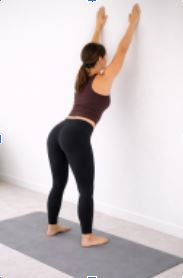
This movement creates space through the torso and ribcage.
How to do it
- Stand with feet grounded.
- Reach arms overhead or place hands on a wall.
- Allow the spine to lengthen while keeping feet supported.
- Take three to five slow breaths.
Why it helps
-
Creates space in the torso
-
Reduces compression
-
Supports breathing mechanics
Everyday Connection
Helpful for relieving tension after holding or feeding a baby.
6. Foot Awareness and Grounding
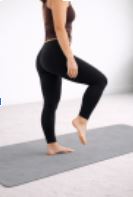
The feet play a major role in posture and balance during pregnancy and postpartum.
How to do it
- Stand with feet hip-width apart.
- Shift weight slowly from heel to toe and side to side.
- Notice where you feel grounded.
- Take several slow breaths.
Why it helps
-
Improves balance
-
Supports whole body alignment
-
Enhances proprioception
Everyday Connection
Supports safer walking, standing, and carrying tasks.
7. 360 Expansive Breathing
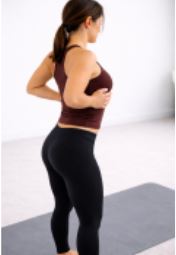
This breathing pattern encourages full ribcage expansion without belly gripping.
How to do it
- Place hands around your ribcage.
- Inhale and allow the ribs to expand in all directions.
- Exhale gently without pulling the belly in aggressively.
- Repeat for five to ten breaths.
Why it helps
-
Supports core coordination
-
Improves breath efficiency
-
Reduces unnecessary tension
Everyday Connection
Useful before movement, lifting, or moments of stress.
Body Image and Body Patience
Your body is not broken. It is adapting. Pregnancy and postpartum recovery are not linear, and comparison often disrupts healing. Movement should support curiosity, not correction. Strength, comfort, and confidence matter more than appearance.
Practicing patience with your body means honoring rest, respecting boundaries, and choosing movement that feels supportive rather than punishing. Pilates during this season is not about getting your body back. It is about moving forward with awareness and trust.
Bio

Kaylee Costa of Costa Consultation
Email: kay@consultcosta.com
Instagram: @costaconsultation
Website: www.consultcosta.com
Kaylee Costa is a perinatal wellness practitioner specializing in pregnancy and postpartum support through movement, lactation, and education. She is an International Board Certified Lactation Consultant and works with families to build sustainable, evidence-based feeding and movement practices that respect the realities of pregnancy, birth, and early parenthood.
Her work focuses on helping perinatal clients reconnect with their bodies through gentle, functional movement, supportive breathing strategies, and individualized guidance that prioritizes safety, autonomy, and long-term wellbeing. Kaylee approaches care through a trauma-informed and whole-body lens, recognizing that each client’s history, goals, and capacity are unique.
She currently supports families through private consultations and perinatal movement sessions, with a particular interest in postpartum recovery, body awareness, and realistic return to movement. Kaylee is also a mother herself, which deeply informs her compassionate and practical approach to care.